


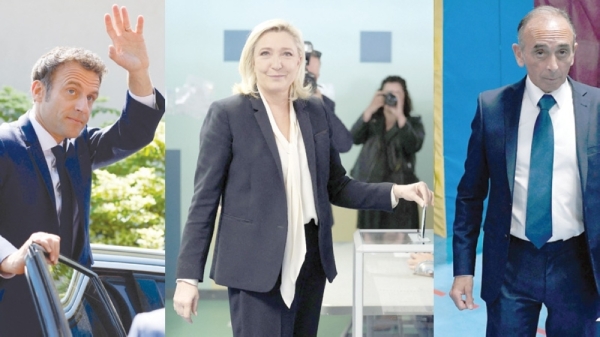
PARIS: French voters were heading to the polls on Sunday for the run-off vote between incumbent President Emmanuel Macron and far-right nationalist challenger Marine Le Pen in an election that could have ramifications far beyond France’s borders.
Macron voted in the northern town of Le Touquet-Paris-Plage, accompanied by his wife, Brigitte, in the race that is set to determine whether he will keep his job for another five years.
Le Pen, of nationalist Rassemblement National (National Rally) party, voted in the northern town of Hénin-Beaumont, near Lille.
Pro-European, liberal Macron led his rival in most polls ahead of the closely-watched race, with a lead of between 55 per cent and 56.5 per cent.
By noon, 26.41 per cent of voters had cast their ballots, the Interior Ministry said. Turnout was marginally higher than the 25.48 per cent who had cast their ballots by noon in the first round of voting that took place two weeks ago.
Some 48.7 million French citizens are eligible to vote for Macron or Le Pen, who are facing each other in a run-off for the second time.
Compared to the run-off vote five years ago that sent Macron to the Élysée Palace, turnout levels were slightly lower, with 28 per cent having cast their ballot by noon in 2017.
Since the first round of voting on April 10, the lawmakers have been feverishly campaigning to win supporters who backed hard-left candidate Jean-Luc Mélenchon, who came third in the first round.Persuading disenchanted voters to head to the polling booths will also be critical.
Macron has been emphasising his commitment to climate protection. Meanwhile Le Pen is calling for the constitution to be altered to allow for preferential treatment of French citizens when it comes to access to social welfare and housing.
Many politicians and journalists called on the public to back Macron in the second round, hoping that Le Pen will be definitively defeated as she was in 2017.
Macron won then with 66 per cent, but the result is expected to tighter on Sunday.
The decisive vote is also being closely watched by lawmakers in Brussels, Berlin and Washington, as Le Pen’s aims include fundamentally altering the European Union by giving national law primacy over European Union law, for example.
Macron’s re-election meanwhile is widely seen as a guarantor for stability and continuity in French foreign relations.
French presidents are elected for five-year terms, to a role that has a major influence on the country’s politics and greater power than the prime minister, who is appointed by the president.
Initial projections were expected as soon as all polls close at 1800 GMT. Some voters already cast their ballots on Saturday in French overseas territories such as the Caribbean.
Once a winner becomes clear, the candidates have each made plans to greet their supporters. Macron is preparing to receive his backers at the Champ-de-Mars near the Eiffel Tower in Paris, ‘Le Parisien’ newspaper reported.
Le Pen plans to start from Bois de Boulogne then parade through Parisin a rally made up of 13 campaign buses. Her rally would make stops at famous landmarks such as the Arc de Triomphe, the Place de la Concorde and the Place de la République in Paris, before returning to a location in the capital that has not yet been revealed.
It is not clear what the candidates are planning to do if they are defeated.
Ahead of the vote, numerous French media outlets called on voters to return Macron to the Élysée Palace, with some saying a Le Pen victory would make France an unreliable partner abroad and would disrupt national unity. — dpa