

Mohammad, 17, emerged groggily from his hotel near Heathrow Airport into the spitting rain on Thursday, his flimsy sandals slapping at the wet concrete.
It has been weeks since he slept or ate properly, he said.
He crossed his arms and shivered, then gazed up at the sky as a plane roared overhead. Before he was taken to the hotel, Mohammad said, he spent 25 days at the Manston migrant centre on England’s southeastern coast.
Recounting his time in the troubled Manston center, Mohammad, who is from Iraqi Kurdistan, described how asylum-seekers had been forced to sleep in chairs in freezing temperatures, adding that many had become sick in overcrowded tents. He said that he had been fed too little and often gone hungry, that many people were “filthy” because there weren’t enough showers, and that he had been prevented from contacting his family in Iraq to let them know that he had survived the perilous journey across the English Channel.
“All migrants are suffering in Manston camp, believe me,” he said. “It is not a situation that humans deserve to live in.”
As a minor, Mohammad’s last name has been withheld to protect his privacy.
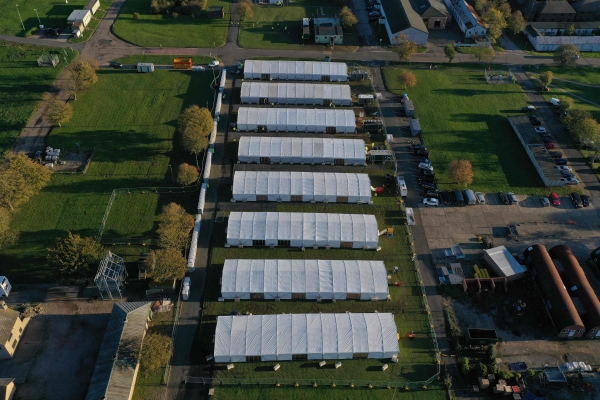
He is just one of thousands of asylum-seekers who have passed through the Manston centre since it opened in January, many of them children. The centre has been racked in recent weeks by mounting allegations of inhumane conditions, including severe overcrowding, and has found itself at the centre of heated debate about migrant policy that has roiled Prime Minister Rishi Sunak’s new government.
On Friday, a Home Office spokesperson said “it is still the case that Manston remains resourced and equipped,” when asked to respond to accusations of poor and dangerous conditions. Still, the Home Office had said on Thursday that it had been taking steps to “immediately improve the situation on the ground,” adding that 1,000 people had been relocated from the centre over five days. As of Thursday, Manston was holding almost double its capacity.
Manston was built to hold 1,600 migrants, but in recent weeks, it had housed around 4,000.
Mohammad’s account could not be independently verified, but his depiction of the conditions at Manston generally aligned with inspection reports from immigration officials and interviews by The New York Times with union officials who had spoken with staff members at the centre.
And when shown photographs of the facility, Mohammad was able to identify it, without prompting, as the one at Manston. He was one of four teenagers interviewed by the Times at the hotel who recounted harsh conditions at the centre. Mohammad spoke in his native Kurdish, and the Times translated his account.
The Times also viewed transcripts of interviews by two aid organisations, the Refugee Council and Humans for Rights Network, with other teenagers who had been housed at Manston. They described similar hardships to those detailed by Mohammad, saying that they had often gone hungry because of a lack of food. Some said that they had been forced to sleep while sitting up at night because of the cramped conditions and that they had been refused medical attention because of staff shortages.
One boy, a 16-year-old from Sudan, said he had spent nearly three weeks sleeping on discarded food boxes with just one set of soggy clothes — an experience, he noted, that reminded him of the harsh conditions he had endured in Libya’s detention camps.
“I used to sleep during the day to stay awake at night because I was afraid of nightmares,” he said of his time at Manston.
The aid groups’ interviews were shared with the Times without the names of the migrants attached to protect their privacy. Most are now living in the care of local authorities elsewhere in Britain, the aid groups said, although some are still staying unaccompanied in hotels.
Official rules for short-term migrant holding facilities stipulate that asylum-seekers are supposed to stay there for only a day, but many — including young children — have been held at Manston for weeks, according to inspection reports, aid groups and interviews with migrants.
The crisis at Manston has engulfed Britain’s home secretary, Suella Braverman, who has been accused of ignoring legal guidance to relieve the overcrowding and find housing for the asylum-seekers there. She denied those accusations in Parliament on Monday, but she did say that the asylum system was “broken.”
On Wednesday, the leader of the opposition Labour Party, Keir Starmer, seized on that statement. Noting that the Conservative Party had been in power since 2010, Starmer pressed Sunak. If the asylum system was indeed broken, Starmer said, “Who broke it?”
Braverman visited the site on Thursday.
According to the Home Office, close to 40,000 people have crossed the English Channel by small boat this year — the highest number since figures began to be collected in 2018. Nearly all of them have claimed asylum, which has contributed to a backlog of 127,000 applications, according to official figures.
Outside the airport hotel on Thursday, Rohullah Bilimsevar, 28, and Ramin Karwan, 29, huddled together in the cold, both still dressed in the same thin jogging suits they had been given after arriving at the Manston centre more than a month ago. They said that they were former journalists from Afghanistan and showed documents to that effect. They said that they had been moved out of the centre on Wednesday.
“There are no beds for sleeping. No food. There were lots of children there,” said Bilimsevar, who noted that he had fled Afghanistan after the Taliban took power.
He added that there were 200 people in one tent and that each person got just one blanket.
Union officials representing immigration staff at the centre have also raised concerns about the conditions there.
Lucy Moreton, an officer and former general secretary of the Union for Borders, Immigration and Customs, said that illnesses such as drug-resistant staphylococcus infections, scabies and diphtheria had all been detected among asylum-seekers at Manston.
She added that there were just three general practice doctors at the facility and that they were working 16 hours a day.
At the hotel near Heathrow, Mohammad said that he feared what lay ahead for others at Manston.
“They are suffering,” he said.
