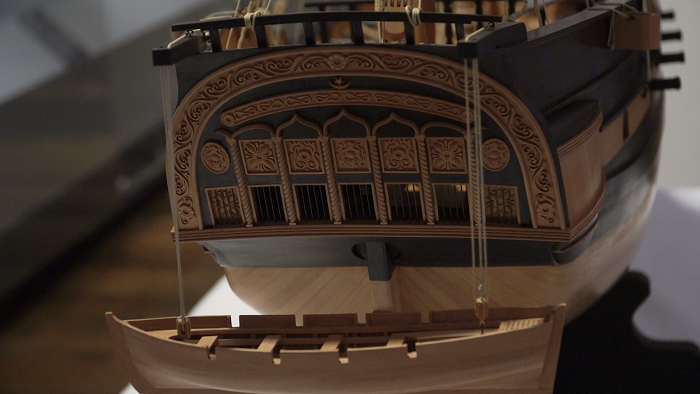


Muscat: The National Museum has put on display a model of Muscat armed baghla (1253-54 AH/1838 CE).
The model took four years to manufacture and is made of pear wood, ebony, linen, canvas, metal and brass, at a scale of 1:25. This model embodies Oman’s perfection and craftsmanship in ship-building.
The baghla was the largest deep-sea trading and cargo vessel of the Arabian Gulf, and the most ornate of the big Arabian ships.
She was fitted with two or occasionally three masts and was distinguished by ornamental projections that resembled the quarter galleries found on European line-of-battle ships of the 12th-13th century AH/18th-19th century CE.
The stem-post curved gently upward to a stem-head which was topped with a bollard-shaped decoration – a further form of ornamentation peculiar to the baghla.
Although the baghla was predominantly a merchant vessel, it could also be effectively armed for use in warfare.
This model represents an armed baghla, measuring approximately 40 metres long and 45 metres high, fitted with ten 12-pounder Blomefield pattern cannons.
In the early 13th century AH/19th century CE, the Blomefield was regarded as the most efficient breaching weapon.
Oman has had a long relationship with the sea. With an extensive coastline, the story of Oman’s past is in many senses a maritime history. For millennia, fishermen sailed along its coasts for their livelihood.
Omani traders carried goods across the seas as early as the third millennium BCE, and by the Islamic Period, they were part of a vast trading network that extended from China to East Africa, the single longest maritime trade route at the time.
In the last four centuries, Omanis had established two maritime empires that connected Oman with the Arabian Gulf, Makran Coast and East Africa. All of this activity has shaped the maritime culture of Oman.
As Omanis braved the seas, they became excellent navigators and produced a rich navigational literature. They developed an active tradition of boatbuilding, using the materials and tools available to them to build a wide variety of vessels.
Today, Oman continues its relationship with the sea. It has modern navy, prosperous seaports, and leads the region in historical reconstructions. This sea-craft is a symbol of Oman’s interaction with the rest of the world.