


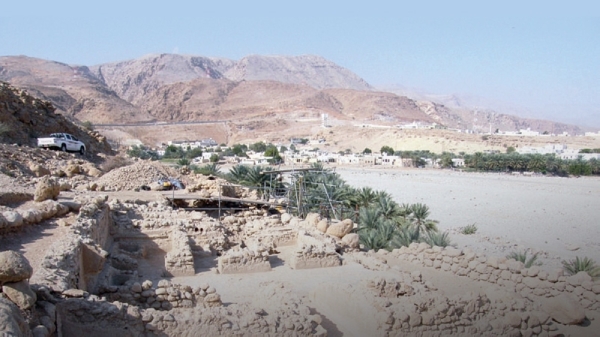
A shining jewel along the Omani coastline, the historic city of Qalhat, located in Sur in the Southern part of Al Sharqiyah Governorate has gained its significance over millions of years for its exceptional pieces of evidence of the greater international trade history of Oman.
Qalhat presents a unique testimony to the many characteristics of Omani civilisation and its history which dates back to the Bronze Age. With its unique and distinctive location, the port city enjoyed the advantage of attracting travellers, explorers and seekers after knowledge.
Qalhat was declared as a Unesco World Heritage Site in 2018 for its possession of historic and archaeological sites as well as for the discovery of artefacts from countries like Persia and other Asian countries.
Archaeological researches at Qalhat delivered the vestiges of a whole port city of the Middle Ages with all its main features, its various quarters and street networks, the fortifications and gates, the great Friday Mosque and other religious buildings, a souq and a warehouse, workshops and dwellings and several administrative and public edifices.
In addition, there is a hammam (Public Bathing), the only building of this kind ever found in the Sultanate of Oman, which was first discovered during preliminary excavations in 2003.
According to a research report in ‘The Journal of Oman Studies’, the hammam was most probably built, together with the north fortified gate of the ramparts, during the heyday of the city under the reign of the governor Sayf al Din Ayaz and his wife Bibi Maryam, around 1280-1320,
The hammām was probably in use throughout the 14th century, and at least during part of the 15th century, but the date of its abandonment remains unknown.
“The hammam of Qalhat is an extremely interesting building. It is, first of all, the only hammam ever built in the Sultanate of Oman, past and present, and as such it is a unique testimony of the Omani architectural heritage, and the main asset for our knowledge of the history of Qalhat”, the researchers point out in the report.
According to the report in the ‘Journal’, which is published by the Oman Ministry of Heritage and Tourism, Qalhat underwent the main development during this period as the second capital of the Hormuz kingdom, which was then developing as a leader of the Indian Ocean trade.
As the structure of the hammam was planned to be conserved by a team of the Qalhat Development Project during its 2016-2017season, a comprehensive study was launched in fall 2015 by the archaeological team.
The backfill which had been carefully placed over the entire surface in 2003 to protect the floors was first removed, a further room was discovered and excavated east of the building, additional excavations took place in the fire chamber and service area to the west, and a detailed architectural and technical analyse was performed.
“The Qalhat hammam differs from others in the Middle East, during the pre-Islamic and Islamic periods, and it is therefore of great interest for our knowledge of this very specific type of buildings, and for the history of Islamic architecture as well”, the researchers claim.
The bathhouse tradition in the Arabian Peninsula is rather recent and, at the moment, no example has been found yet for the pre-Islamic period in this area. However, the presence of baths is attested at that time in peripheral regions.
In Qalhat, the hammām has a centred plan on the hot rooms and a hypocaust, which could thus indicate a Seljuq architectural influence. As is the case for the nearby Bibi Maryam mausoleum, the Turkish origin of the Hormuzi governor Baha al Din Ayaz Seyfin and his wife Bibi Maryam possibly explains this influence.
In all cases, their Hormuzi background explains the presence at Qalhat of such a public facility, totally foreign to local traditions.
“Data on 14th-century Arabian hammams is therefore very scarce, and this makes difficult the comparison work and the study of the architectural influences at work in the hammam of Qalhat”, concludes the report.
The hammam is located near the northwest extremity of the site, on a sloping terrace against the steep rocky bank of the Wadi Hilm, down the western tip of the town wall at the foot of the. It is only via this terrace, probably of natural origin, that the coastal track could connect the wadi bed and the plateau where the site stands, and this area was the main access to the city on its north side.
Rectangular in shape, its access was from the east, down from the upper terrace along the wadi wall, probably with steps, although this part is now eroded.
The height of the wadi wall superstructures above the level of the terrace is unknown, so we do not know whether the passage between this wall and the hammām looked like a corridor, or if the view was open on the wadi side.
Picture courtesy: ‘The Journal of Oman Studies’


